A property buyer in Tamil Nadu checking whether a project is TNRERA registered might reasonably assume that the registration confirms everything about that project is legally clean. A Madras High Court ruling delivered on September 19 makes clear that this assumption is incorrect and potentially dangerous.
Justice D Bharatha Chakravarthy ruled that a TNRERA registration does not settle questions of property title. When title ownership is disputed, that dispute must go to a civil court. TNRERA registration does not resolve it and does not prejudice the rights of anyone involved in a civil title case.
What the Tambaram Case Actually Involved
A petitioner named N Balakrishnan approached the High Court challenging a TNRERA registration granted for a development project on land in Tambaram. The developer, S Anandhan, had obtained TNRERA registration for the project while a civil suit over the ownership of that same land was still pending in court.
Balakrishnan’s core argument was that the developer had not disclosed the pending civil dispute when applying for TNRERA registration. Section 4 of the Real Estate Regulation and Development Act requires applicants to disclose encumbrances and disputes. The absence of that disclosure, he argued, made the registration itself defective.
The court declined to quash the registration. The project was already at an advanced construction stage, making revocation impractical. The court disposed of the petition while making its position on TNRERA’s jurisdiction over title disputes explicitly clear.
What This Means for Property Buyers
The ruling carries a direct implication for anyone using TNRERA registration as a proxy for legal cleanliness in a project. TNRERA verifies that a project meets regulatory requirements for registration under the RERA Act. It does not conduct a title search. It does not confirm that the land the project sits on is free from ownership disputes in civil court.
A TNRERA registration number on a project page tells a buyer that the developer has registered the project with the regulatory authority. It does not tell a buyer that no one else is claiming ownership of the land through a civil suit.
The Check That TNRERA Registration Does Not Replace
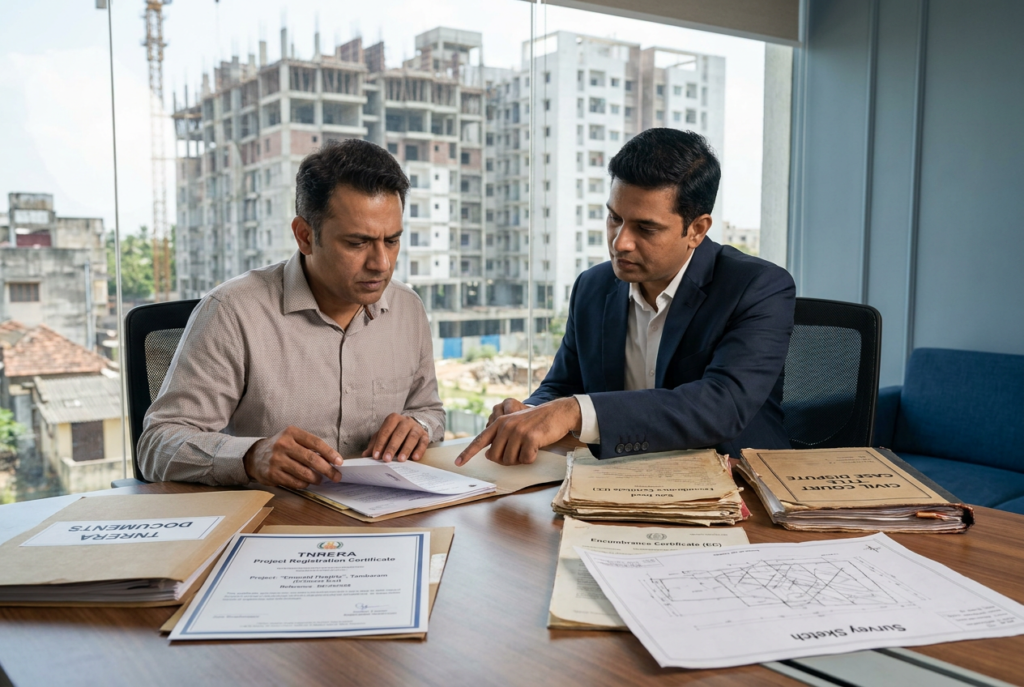
Independent title verification through a property lawyer, an encumbrance certificate review, and a search for any pending civil suits connected to the survey number remain essential steps before any property purchase in Tamil Nadu. TNRERA registration is one layer of due diligence. It was never intended to take care of everything.
This ruling makes that boundary explicit. Civil title questions belong in civil courts. TNRERA’s jurisdiction ends where title ownership disputes begin.