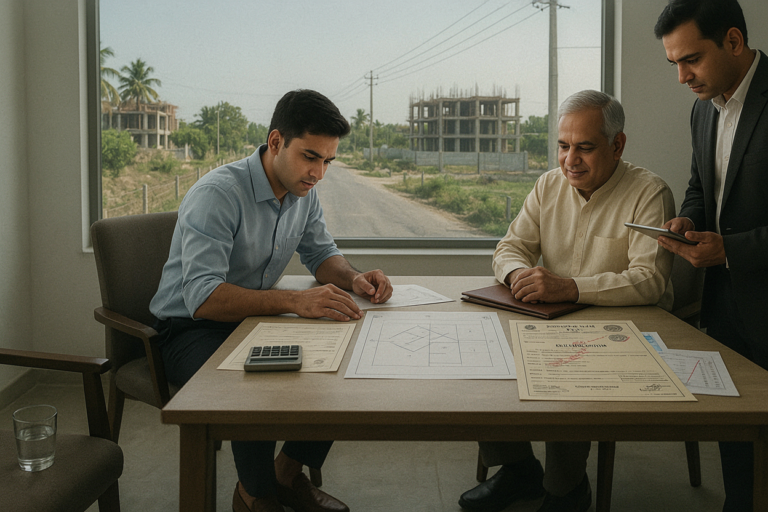

Deepa had a budget, a location preference, and three months to make a decision. What she did not have was any framework for deciding between the eleven different plots she had shortlisted across four localities in South Chennai.
Every plot had something going for it. Every plot had something slightly off. She kept visiting, kept comparing, and kept postponing until a retired civil engineer she met through a relative sat down with her one afternoon and reorganised how she was thinking about the entire problem.
He did not tell her which plot to buy. He told her which questions to ask about each one in what order. By the end of that conversation, her eleven options had narrowed to two. Within a week, she had registered one of them.
The Questions That Filter Quickly and Ruthlessly
Start With What Cannot Be Changed Location Fundamentals
The retired engineer told Deepa something she had not heard framed this way before. Everything about a plot can potentially be improved the internal roads, the compound wall, the landscaping, the amenities nearby. But the location itself is permanent. The direction a plot faces, what sits adjacent to it, and what infrastructure exists around it cannot be altered after purchase.
His first filter was simple for each of the eleven plots, ask what exists within two kilometres that generates sustained daily human activity. Employment centres, schools, hospitals, transit hubs, and commercial areas all create the kind of consistent footfall that drives residential demand over time. A plot surrounded by nothing but other undeveloped plots has no such anchor. Its appreciation depends entirely on future promises rather than present reality.
Four of Deepa’s eleven plots failed this filter immediately. They were in areas where the pitch was entirely about what was coming not what was already there.
Legal Clarity Is Not a Later Step It Is the First One
The engineer’s second filter was documentation but not as a verification exercise that happens after emotional commitment. As the first gate every plot must pass before it earns a site visit at all.
DTCP or CMDA approval, encumbrance certificate, and patta ownership records these three items tell a buyer whether the land is legally recognised for residential use, whether any financial or legal claim sits against it, and whether the person offering to sell it has the government’s own recognition as its owner.
Three more of Deepa’s eleven plots fell away at this stage. One had an encumbrance entry that the promoter had not disclosed. One had a layout approval that was not findable on the government portal. One had a patta in a name that did not match the seller.
Four plots remained.
The Physical Assessment That Documents Cannot Replace
What the Ground Tells You That No Paper Can
With four plots surviving the first two filters, the engineer joined Deepa for site visits. His approach was methodical in a way that her previous visits had not been.
He checked the slope of each plot land that slopes toward the road drains well and avoids waterlogging. He checked the soil colour at the lowest corner dark, damp-looking soil in dry weather is a warning sign about how the plot behaves during monsoon. He walked the boundary and compared physical markers against the survey map confirming that the corners on the ground matched the corners on the document.
He also spent time looking at what was directly adjacent to each plot. A plot bordered by a stormwater drain, a high-tension power line, or a commercial activity that generates noise and waste has limitations that the layout plan will never show clearly.
Two plots passed all of these physical checks cleanly. Two did not.
The Final Decision Price Against What You Actually Have
Deepa was left with two plots that had passed every filter. One was ₹2.5 lakhs cheaper than the other. The cheaper one was in a slightly less active location with fewer adjacent development signs. The engineer asked her one last question. If you needed to sell this plot in five years, which of these two would find a buyer faster?
She chose the more expensive one. He agreed with her reasoning. Choosing the right plot of land is not about finding the perfect option. It is about applying the right filters in the right sequence so that by the time price enters the conversation, everything that matters more than price has already been resolved.