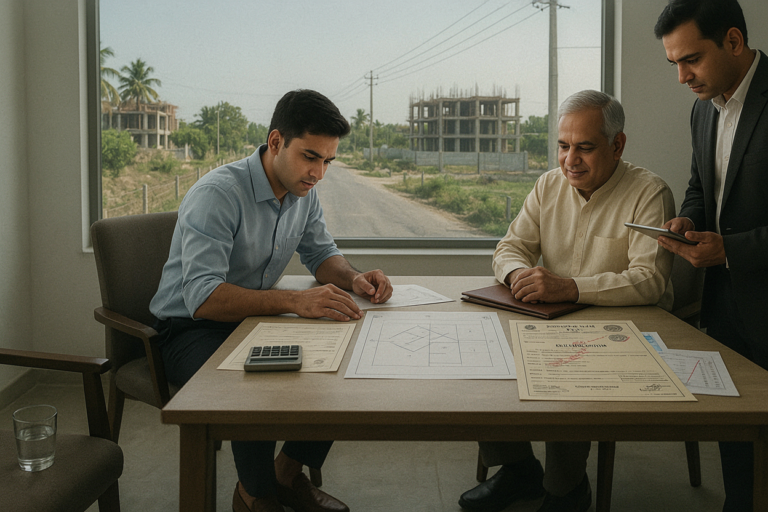

Anbu and his brother Senthil grew up in the same house, went to the same school, and started working around the same time. By their early thirties, both had similar salaries and similar savings. Then they made different property buying decisions and everything that followed was different too.
Anbu bought a DTCP-approved plot in Guduvanchery in 2018 for ₹16 lakhs. He stretched a little to make it work. Senthil decided to wait prices were high, the location felt peripheral, and the timing never seemed quite right.
Today, Anbu’s plot is valued at ₹44 lakhs. He has taken a construction loan against it to build a house. His asset is working for him. Senthil is still renting still waiting for a correction that has not arrived and the same plot now costs more than he can comfortably afford.
One decision. Seven years apart in outcome.
Why Property Decisions Carry Long-Term Consequences Most Buyers Underestimate
Every property buying decision whether to buy or wait, which location, which type of asset, which developer sets a chain of consequences in motion that plays out over years and sometimes decades.
A well-chosen property in a growth corridor does not just appreciate in price. It builds collateral that enables future borrowing. It generates rental income that supplements monthly earnings. It provides a foundation against which construction loans can be structured. And it creates a psychological security the knowledge that something tangible and valuable is growing in the background that influences financial behaviour in ways that are difficult to measure but very real.
A poorly chosen property does the opposite. It locks capital into an asset that stagnates. It creates EMI pressure without corresponding appreciation. It limits flexibility when better opportunities arise. And it frequently results in a distressed sale at a loss when circumstances change.
The difference between these two outcomes is almost never about luck. It is almost always about the quality of the initial decision.
What Separates a Good Property Buying Decision From a Costly One
Three factors consistently separate property buying decisions that build financial futures from ones that damage them.
Location discipline is the first. Properties in corridors with genuine infrastructure momentum improving roads, employment centres, expanding connectivity appreciate predictably over time. Properties in isolated locations without a verifiable development story around them rarely do. The temptation to chase lower prices in locations with no growth story is one of the most common and most costly mistakes buyers make.
Legal clarity is the second. A property with clean title, verified approvals, and a transparent encumbrance history is a foundation worth building on. A property with unclear documentation is a liability dressed as an asset regardless of how attractive the entry price appears.
Timing discipline is the third and perhaps the most psychologically difficult. The buyers who consistently build wealth through property are not the ones who time the market perfectly. They are the ones who stop waiting for a perfect entry point that rarely arrives and make well-researched decisions based on current fundamentals rather than hoped-for corrections.
Anbu was not a sophisticated investor. He simply found a location he could verify, a developer whose completed work he could visit, and a price his budget could handle. Then he committed.
That decision made once, with discipline and patience is still working for him seven years later. Property buying decisions do not announce their consequences immediately. They deliver them quietly, over time, in the form of a financial future that either opens up or closes down depending entirely on the quality of the original choice.