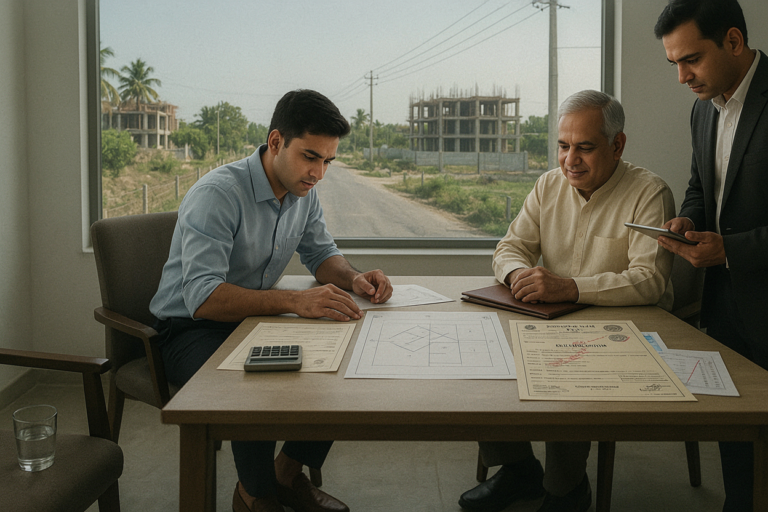
Deepak booked a “1200 sq ft” apartment near Sholinganallur. He was excited that sounded spacious for a two-bedroom. When the interior team came to measure for furniture after possession, the actual usable floor space came to just under 850 square feet.
He called the builder, convinced something had gone wrong. Nothing had. The builder simply explained three words Deepak had heard during the sale but never properly understood carpet area, built-up area, and super built-up area.
That gap between 1200 and 850 was not a mistake. It was math he had never been shown clearly.
The Three Numbers That Describe the Same Flat Differently
Carpet Area What You Can Actually Walk On
Carpet area is the simplest of the three. It is the actual usable floor space inside your flat the area you could cover with a carpet, wall to wall, excluding the thickness of the walls themselves. This is the space where your furniture goes, where you walk, where you live.
For Deepak’s apartment, the carpet area was approximately 850 square feet. This is the number that most accurately represents the living space he actually received.
Built-Up Area Carpet Area Plus the Walls
Built-up area adds the thickness of the walls both internal and external to the carpet area. It also typically includes the area of balconies attached to the unit.
This number sits between carpet area and the final figure quoted in marketing. For Deepak’s flat, the built-up area came to roughly 980 square feet about 130 square feet more than carpet area, accounted for by wall thickness throughout the apartment and the balcony space.
Super Built-Up Area Your Share of Everything Common
Super built-up area is where the bigger jump happens and where most buyers lose track of what they are actually paying for.
This figure takes the built-up area and adds a proportional share of all common areas in the building lobbies, staircases, lift shafts, corridors, and sometimes amenity spaces like the clubhouse or gym, depending on how the builder structures the calculation.
For Deepak’s apartment, this additional loading brought the quoted figure up to 1200 square feet meaning roughly 220 square feet, or about 18 percent of what he was quoted, represented shared spaces he would never exclusively occupy.
Why This Loading Percentage Varies So Much Between Projects
What Drives the Gap Between Carpet and Super Built-Up
The loading percentage the difference between carpet area and super built-up area typically ranges from 20 to 35 percent depending on the project. Buildings with extensive common amenities, wide corridors, multiple lifts, and large lobbies carry higher loading. Simpler, more compact buildings carry less.
Neither extreme is automatically better or worse. A higher loading percentage might mean genuinely better common facilities or it might simply mean the buyer is paying premium rates for square footage they will only pass through.
What Deepak Wishes He Had Asked Before Booking
He wishes he had asked for the carpet area figure upfront in writing before signing anything. He wishes he had asked for the exact loading percentage and understood what it included.
These two questions take less than two minutes to ask during a site visit. They reveal exactly how much usable living space a buyer is actually purchasing regardless of how impressive the headline square footage sounds in the brochure.
Deepak’s flat was not a bad purchase. It was simply a purchase he made without understanding what the numbers meant. Asking those two questions would have given him the same flat with none of the surprise.