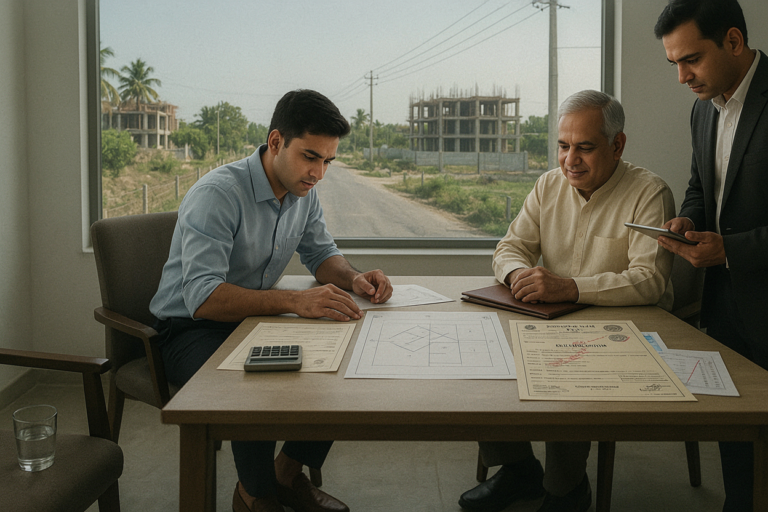

Anand was two days away from paying the full advance on a plot near Guduvanchery when his brother-in-law who worked in a revenue office asked him one question. “Have you checked the patta online?”
Anand had not. He did not even know that was possible. He assumed verifying land records required visiting a government office, waiting in a queue, and hoping the right person was available that day.
His brother-in-law sat him down with a laptop and showed him something that took twelve minutes and changed everything about how Anand approached that purchase.
What Land Records E-Services Actually Give You Access To
A Window Into the Government’s Own Property Records
Tamil Nadu’s land records e-services platform accessible through tnlrs.tn.gov.in and the companion patta chitta portal gives any buyer direct access to the same revenue records that government offices maintain about every piece of land in the state.
From a laptop or phone, a buyer can pull up the patta for a specific survey number and see exactly whose name the government recognises as the current owner of that land. They can check the chitta to understand the land’s classification whether it is recorded as agricultural, residential, or otherwise. They can view the adangal to see a detailed history of how the land has been used and recorded over time.
None of this requires an appointment. None of it requires knowing someone in the right office. It requires a survey number, a district, and about ten minutes.
What These Records Reveal That Documents Alone Cannot
A seller can hand a buyer a photocopy of a title deed. A promoter can produce a layout plan with an approval number. What neither of those documents alone can confirm is whether the government’s own records agree with what is being shown on paper.
Land records e-services close that gap. If the patta shows a different name from the person claiming to sell that discrepancy is a serious red flag that no amount of reassurance should overcome. If the land is classified as agricultural in the chitta while being marketed as a residential plot that classification gap requires explanation and legal resolution before any transaction proceeds.
How to Use These Services Before Any Plot Purchase
The Three Checks That Take Twenty Minutes Together
The first check is the patta confirming that the seller’s name matches what the revenue department holds on record as the current owner. The second is the chitta verifying the land classification matches the intended residential use. The third is the encumbrance certificate through the tnreginet.gov.in portal showing every registered transaction against that property for a defined period.
Together, these three checks create a picture of the property’s legal standing that is drawn from government sources rather than from the seller’s own documents. Any inconsistency between what the seller presents and what these portals show is a signal worth investigating thoroughly before a single rupee changes hands.
What Anand Found in Those Twelve Minutes
The patta came up correctly the seller’s name matched the revenue records. The land classification was residential. The encumbrance certificate showed no outstanding claims.
He completed the purchase with far more confidence than he would have carried otherwise. And the twelve minutes his brother-in-law invested in showing him those portals turned out to be the most valuable part of his entire property buying process.
Land records e-services exist precisely for moments like that to put government-sourced truth in a buyer’s hands before it is too late to act on it.