Rajan’s father bought a small plot near Vandalur in 2009. Back then, the area had almost nothing around it a few scattered houses, open land, and a quiet stretch of GST Road that most people drove through without stopping.
Today, that same stretch has a fully operational bus terminus handling thousands of passengers daily, growing residential colonies, new commercial establishments, and property prices that have moved significantly from where they were fifteen years ago.
Rajan is now looking at a plot three kilometres from his father’s land. And the question he keeps asking himself is whether the next fifteen years will look anything like the last ones.
The answer requires looking honestly at what has already changed and what is still coming.
What Makes Vandalur’s Location Genuinely Strong
The Kilambakkam Advantage Right Next Door
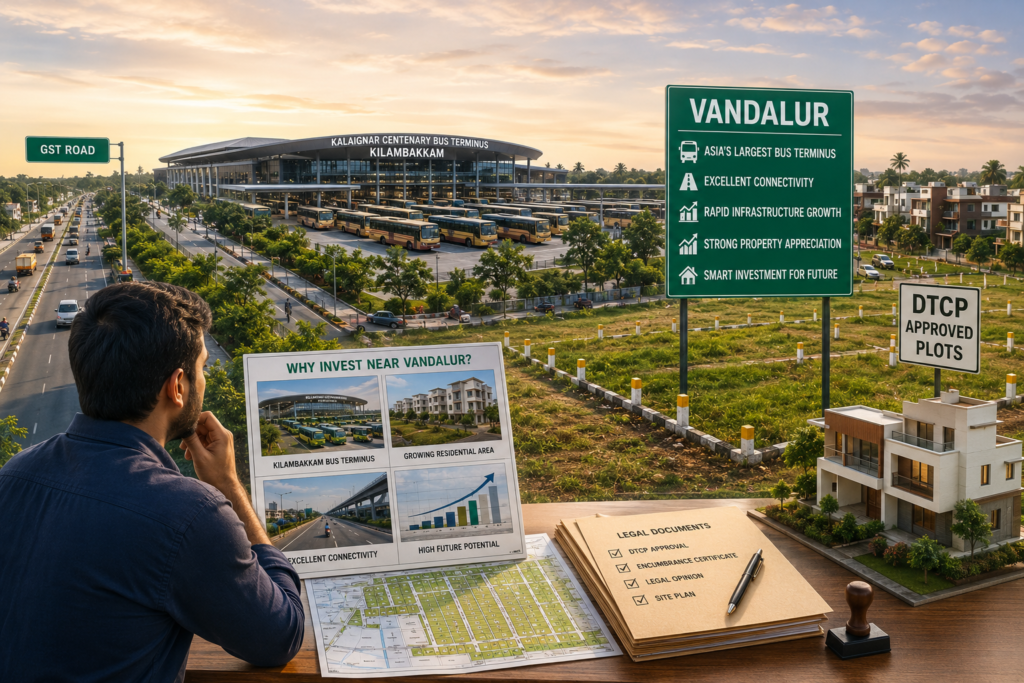
Vandalur sits directly adjacent to the Kalaignar Centenary Bus Terminus at Kilambakkam Asia’s largest bus terminus, now fully operational after years of construction. Spanning nearly 89 acres along GST Road, the terminus handles over 2,300 buses daily and brings enormous passenger footfall into a corridor that was considerably quieter just five years ago.
For property investors, proximity to major transit infrastructure is one of the most reliable indicators of sustained value appreciation. Commercial activity, residential demand, and service sector growth all follow large transit hubs with a predictability that most other infrastructure triggers cannot match.
Vandalur is not speculating on a future terminus. It is sitting next door to one that is already running at scale.
GST Road Connectivity and What It Unlocks
Beyond the terminus, Vandalur’s position along GST Road gives plots here access to one of Tamil Nadu’s most economically active arterial routes. Employment centres, industrial zones, educational institutions, and retail activity line this corridor in both directions. Residents of Vandalur can access Tambaram, Guduvanchery, Singaperumal Koil, and Chennai’s inner corridors without depending on a single route or mode of transport.
This multi-directional connectivity is exactly what gives a location staying power over long investment horizons because it means demand does not depend on one employer, one project, or one infrastructure development doing well.
What Is Still Building Around Vandalur
The Infrastructure Story Has More Chapters Left
The Kilambakkam terminus opening was not the end of Vandalur’s infrastructure story it was a confirmation that the corridor is a genuine government priority. Road improvements, increased suburban rail frequency on lines passing through the zone, and the southward expansion of commercial and residential activity from Tambaram all continue to build the case for this location.
Areas immediately surrounding major transit hubs typically see the strongest property appreciation in the five to ten years following full operational capacity not in the years of construction when speculation peaks. Vandalur is now entering that post-opening appreciation phase, and buyers who understand this timing dynamic are the ones positioning ahead of the next wave rather than chasing it.
Affordability That Has Not Yet Caught Up With Fundamentals
Despite everything that has changed around it, Vandalur still carries plot prices that remain accessible compared to more established corridors like Tambaram’s core or Sholinganallur. That gap between fundamental strength and current pricing is where patient investors have historically found the best long-term outcomes in Chennai’s residential land market.
The gap does not stay open indefinitely. Increased buyer awareness, rising guideline values, and continued infrastructure investment all push it in one direction. But for buyers entering in 2026, that window has not yet fully closed.
What Rajan Eventually Decided
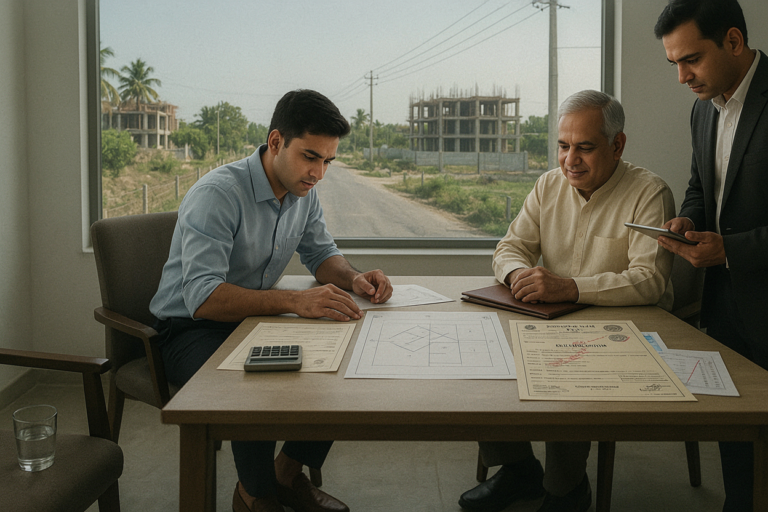
He spent two weekends visiting plots near Vandalur checking DTCP approvals, verifying encumbrance certificates, and standing at the edge of the Kilambakkam terminus watching buses arrive and depart.
What he saw was not a speculation play. It was a location with genuine, already-functioning infrastructure, strong connectivity fundamentals, and prices that had not yet fully reflected either of those realities.
He made his decision based on that and on the memory of his father buying in the same corridor when almost nobody else was paying attention.
Sometimes the most important investment lesson is the one sitting in the family’s own land records.