
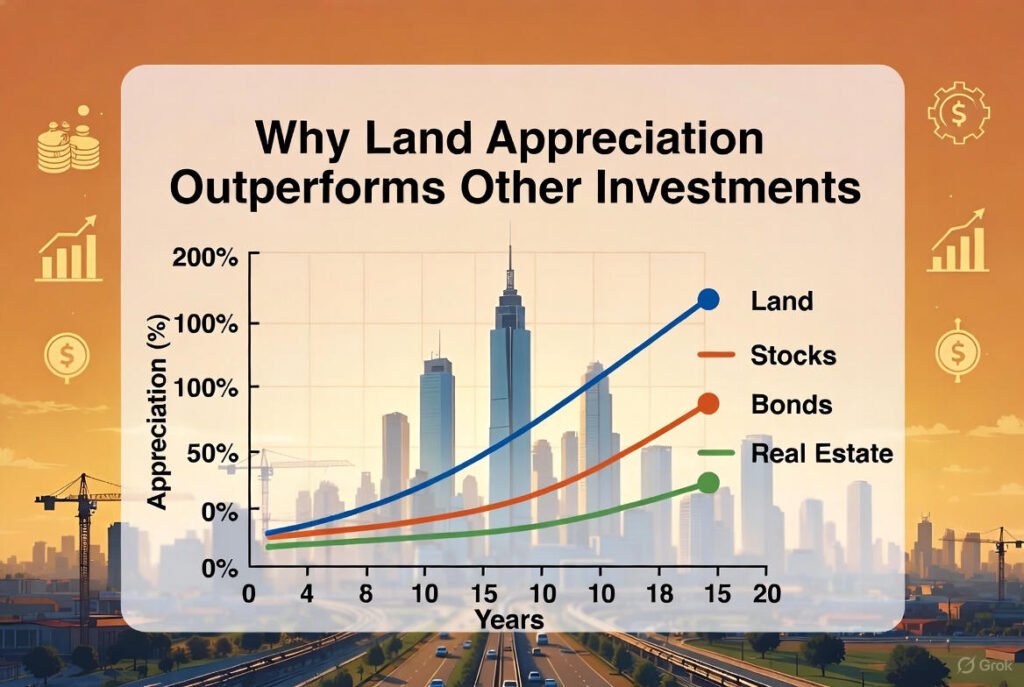
When people talk about building long-term wealth, most think of stocks, gold, or fixed deposits. These are good options, but there is one asset that often grows faster and holds value better than the rest: land.
Land has been a strong wealth creator for generations. Families hold on to it, investors keep looking for it, and prices tend to move upward as cities grow. Even during slow market phases, land rarely loses its core value.
So what makes land appreciation stronger than many other kinds of investments?
The reasons are simple, practical, and based on how people live and how cities expand. This blog explains this in a clear, everyday way so anyone can understand it.
Land Is Limited, but Demand Keeps Growing
Everything we use today can be produced again. New stocks are listed every year. Companies issue more shares. Gold is mined continuously. But land is the only thing that cannot be created again.
The amount of land in a city stays the same, but the number of people living there keeps increasing.
As populations grow, the demand for land goes up. When demand rises and supply stays fixed, prices naturally increase. This is the simplest and strongest reason land appreciates faster.
Cities Expand, and Land Becomes More Valuable
If you look at any major city today, you will notice something interesting:
Areas that were once empty or ignored are now full of homes, offices, shops, and roads.
What caused the change?
Development.
When new facilities come to an area, the land around it becomes more valuable. This may include:
• New roads
• Bus or metro lines
• Schools and colleges
• Hospitals
• IT parks or factories
• Shopping centers
• Residential layouts
A piece of land that looked quiet 10 years ago may now be a prime location.This kind of natural city growth pushes land prices upward year after year.
Land Has No Depreciation
Most assets lose value over time. Cars lose value as soon as you buy them. Buildings need repairs and maintenance. Electronics become outdated fast.
Land has no such downside.
It doesn’t rust.
It doesn’t break.
It doesn’t age.
Even if you don’t develop it, its value stays stable and grows with the area. This makes land one of the safest choices for long-term appreciation.
Land Prices Respond Strongly to Infrastructure
Every time the government announces a new project, nearby land prices start rising. Some examples include:
• Highway expansions
• Overbridges
• Ring roads
• Industrial corridors
• New train or metro stations
• Airport expansions
These projects improve connectivity and attract people. When people move in, businesses follow. Where businesses grow, prices jump.This cycle is why land in fast growing cities becomes more expensive at a quicker pace than many other investments.
More People Want Homes, and That Increases Land Value
Every family dreams of owning a home someday. To build homes, developers need land. As the number of homebuyers grows every year, the demand for land also increases.
This simple need for housing drives long-term appreciation.Even if the economy slows down, people still need a place to live.Because of this steady demand, land rarely goes out of fashion.
You Control Land Better Than Other Investments
Think about stocks or mutual funds. Their value depends on the market, company performance, and economic situations. You can’t influence them.
Land is different. Your decisions can raise its value. Examples include:
• Adding a boundary wall
• Clearing the land
• Obtaining approval
• Improving access
• Selling at the right time
• Holding during growth phases
Your choices have real impact, and this makes land appreciation partly under your control.
Land Is Less Affected by Market Swings
Stock markets rise and fall quickly. Gold prices move with global trends. But land usually stays steady. Even when the country faces inflation, job loss, or political changes, land retains its value because it is tied to people’s basic need for space.
Long-term investors like land because:
• It doesn’t react immediately to economic shocks
• It grows when the city grows
• It always has buyers and sellers
• Banks trust it as security
This stability allows appreciation to continue without big ups and downs.
Early Investment Gives Larger Appreciation
One of the biggest advantages of land is buying early. When you buy land in a developing area, the appreciation can be huge. Small price jumps add up to major gains over 5 to 10 years.
For example:
A plot bought for ₹10 lakh may become ₹20 lakh in a few years if infrastructure grows.
But a fully developed area may not give the same jump.
This early stage opportunity is something stocks or fixed deposits rarely offer.
Land Has Strong Emotional and Cultural Value
In many families, buying land is more than an investment. It’s a symbol of security. It is passed on to children. People store their lifetime savings into land because it feels safe and steady.
This cultural trust keeps land always in demand. When more people want something, its price grows naturally.
Rent or Development Can Increase Returns Even More
Land appreciation is strong on its own, but the returns can become even better if you use the land smartly. Options include:
• Leasing it for parking
• Renting it for small businesses
• Giving it for farming
• Developing residential plots
• Building a small home or shop
• Partnering with builders
These actions add income while the land itself grows in value.
Buying Land Has Lower Entry Risk
If you choose the right location and check documents carefully, the chances of loss are very small. Land doesn’t vanish, and its value doesn’t crash suddenly.
Even if you hold it for a few years without development, you usually end up selling it for more than you paid. This combination of low risk and high appreciation makes land a unique asset.
Final Thoughts
Land appreciation outperforms many other investments because it is limited, always in demand, and closely tied to how cities grow. It doesn’t depreciate, doesn’t depend heavily on market fluctuations, and can multiply in value faster when bought early in developing locations.
For anyone planning long-term wealth, land remains a powerful and reliable choice. With smart location selection and clear documentation, your investment can grow steadily and safely over time.